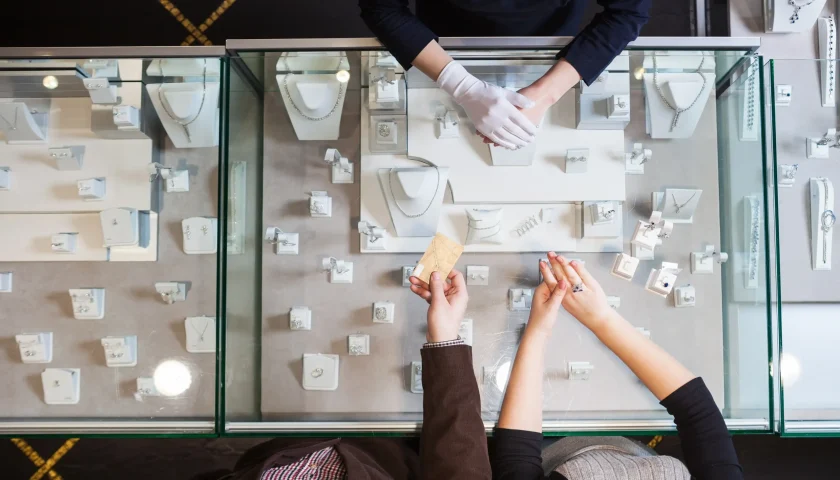
The best way to secure jewelry without hurting sales is to combine three things: a lock on the staff side, glazing matched to your risk level, and a layout that keeps every case in staff view. Glass or laminated glass suits most counters, polycarbonate suits high-risk spots, and a mix of locked and open displays keeps browsing easy.
A jewelry display case has two jobs that pull in opposite directions. It must keep high-value pieces out of reach, and it must let customers see, compare, and ask to try them. A case that is too closed makes people hesitate. A case that is too open invites loss. The sections below cover each decision so you can protect your stock without slowing down sales.
Most jewelry showcases use one of four access styles. The right one depends on how often staff open the case and how valuable the stock is.
The most common choice for counter cases. Staff open the case from behind the counter, so the lock and the track stay on the staff side, away from customers. This also keeps the customer-facing glass uninterrupted, so the display looks clean.
These suit taller showcases and cases where staff need wider access to larger pieces. Check that the hinges are inside or concealed, so customers can’t tamper with them.
Common on low countertop cases and trays. They give easy access for restocking and work well for mid-value merchandise that sits beside the register.
Keypad and card-based locks remove the need to track physical keys and make it easier to change access when staff change. They add cost, so they make the most sense for stores with high-value stock or several people opening cases during a shift.
Whichever style you pick, place the lock on the staff side. Customers should never face a keyhole, and a lock they can reach is a lock they can test.
Glazing is where security and presentation trade off most directly. The table below compares the common options.
Glazing
Clarity
Impact resistance
Scratch resistance
Best use
Tempered glass
Excellent
Good; breaks into small pieces
High
Standard interior counters
Laminated glass
Excellent
Higher; layers hold together when struck
High
Fine jewelry and watch cases
Polycarbonate
Very good
Highest of the group
Lower; scratches more easily
High-risk locations
Glass gives the clearest view and keeps its look for years, which matters when light is doing the selling. Laminated glass adds a bonded layer that holds the pane together when struck, so it resists a break-in better than a single pane. Polycarbonate is the toughest against impact and lighter than glass, but it marks more easily and can show wear over time.
For most stores, glass or laminated glass is the right default. Consider polycarbonate where impact or a smash-and-grab attempt is the main concern, such as an entrance-adjacent case or a location with heavy foot traffic. Performance varies by product, so ask your supplier for the exact specifications of any case you are considering.
Three checks narrow the choice quickly.
Fine jewelry and watches justify laminated glass or polycarbonate and a stronger lock. Fashion and costume pieces rarely do, and they sell better when customers can handle them.
A case beside the entrance or in a high-traffic aisle faces more risk than one behind the register. Match the glazing to the location, not just to the product.
One owner with one key needs a simple lock. A team working several shifts benefits from a lock that is easy to rekey or a keyless option that makes access changes simple.
Layout does as much security work as the lock. The goal is a setup where staff can see every case from where they naturally stand.
Use low-profile cases along the main sales path and keep tall fixtures and signage off the sightline between the staff position and the cases.
Place fine jewelry and watches near the register or service point, and use the outer cases for lower-value or more durable items.
A one-tray-at-a-time rule lets staff stay in control and helps customers focus on a small set of pieces, which often makes decisions easier.
A case in a corner or alcove that staff cannot see is hard to protect. Reposition it or add a mirror if it cannot move.
Good lighting inside the case makes stones and metals stand out. Lighting that reflects off the glazing hides the product, so angle fixtures to avoid glare.
For the wider floor around your cases, see our guide on designing a retail floor plan that increases sales. Our store design services cover counter and floor planning, and the project gallery shows how different retailers have arranged their displays.
Obvious security makes customers feel watched, and it slows browsing. The better approach is security that reads as service.
Greet every customer and offer to bring pieces out. Attentive staff are a strong deterrent, and the offer feels helpful rather than defensive. Keep locks and tracks out of the customer’s view, and choose cases with clear glazing and slim frames so the jewelry stays the focus.
A hybrid setup often works best. Keep fine jewelry in locked showcases behind your counters, and put lower-value or fashion pieces on open-access jewelry displays such as trays and stands so customers can handle them freely. Browsing stays easy where the risk is low, and protection stays strong where the value is high.
A secure jewelry display is built from three choices working together: a lock on the staff side, glazing matched to your risk level, and a layout that keeps every case in staff view. Mixing locked showcases with open displays protects your high-value stock without slowing down browsing.
The most secure jewelry display case pairs laminated or polycarbonate glazing with a high-quality lock on the staff-side doors. No single feature does the job alone: a strong lock on weak glazing, or strong glazing on a basic lock, leaves a gap. Pair both, then place the case where staff can see it from their working position.
Neither wins in every situation. Glass, especially laminated glass, offers better clarity and scratch resistance, so pieces look their best. Polycarbonate resists impact better and weighs less, but it scratches more easily. Choose glass for most interior counters, and consider polycarbonate where impact or a smash-and-grab attempt is the bigger concern.
Place the lock on the staff side of the case so customers never face a keyhole and it stays out of their reach. Rear sliding doors are the most common arrangement for counter cases. Keep keys with authorized staff only, and re-key the case if keys are lost or an employee with access leaves.
Rely on layout and service rather than obvious surveillance. Open sightlines from the staff position, low-profile cases, and a one-tray-at-a-time rule let you keep control quietly. Greeting every customer and offering to bring pieces out is both good service and good security, because attentive staff strongly deter theft.
Usually not. Low-cost costume pieces can sit on open-access fixtures such as countertop trays, bust forms, or racks so customers can handle them freely. Reserve locking cases for fine jewelry, watches, and any item where a loss would hurt. Many stores use both: a locked case for high-value stock beside an open display for impulse purchases.
Miami Display can review your space, inventory, and budget to recommend the right mix of showcases, counters, and open jewelry displays. For Miami-area locations, we offer on-site measurement; for other locations, we can work from your shop drawings.